
Design trends in cabinetry move slower than furniture or paint, which is a good thing. You live with your cabinets for fifteen to twenty years. Chasing what’s popular in a showroom right now is a fast way to end up with something that looks dated before you’ve finished paying it off.
That said, there are real shifts worth knowing before you finalize your choices – some stylistic, some practical improvements the market has finally caught up to. What’s changed in cabinet design for 2026, and what’s starting to look like a specific moment in time.
White Is Fading, Warm Neutrals Are In
The all-white kitchen dominated for the better part of a decade. It’s not gone, but it’s no longer the default answer.
What’s replacing it is a range of warmer neutrals: greige, taupe, cream, clay, and warm off-whites that have yellow or sand undertones rather than blue or grey. These colors read as clean and timeless without the sterile quality that a stark white kitchen can develop, especially in natural light.
The shift makes sense. White shows everything. It’s unforgiving with kids, pets, and any kitchen that gets actual use. Warm neutrals hide the everyday evidence of a working kitchen while still keeping the space bright and open.
If you’ve been looking at paint swatches wondering why crisp white suddenly looks flat, this is why. The eye has recalibrated.
Wood Grain Is Back in the Kitchen
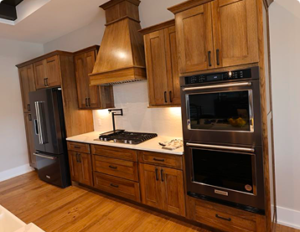
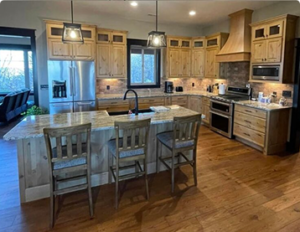
Painted cabinets pushed natural wood grain out of fashion for a stretch. It’s back, and white oak is leading it.
White oak has a consistent, tight grain that photographs well, stains beautifully in lighter washes that let the natural color show through, and pairs with both modern and traditional hardware without forcing either direction. White oak cabinets with a natural or light honey finish feel current in a way that oak finishes from twenty years ago simply didn’t.
Walnut is also trending, particularly on islands and accent cabinets while the perimeter stays painted. The contrast between a dark walnut island and cream or greige uppers and lowers creates visual depth without the design requiring any single bold move.
This return to visible wood grain is partly a reaction to the years of everything being painted. It’s also an honest acknowledgment that natural wood ages well in a way that painted surfaces don’t always.
Two-Tone Cabinets Are Still Growing
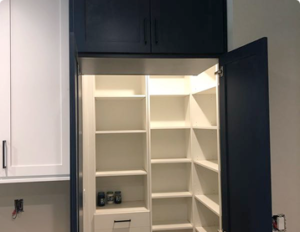
Two-tone kitchens have been building momentum for a few years and haven’t peaked yet. The most common execution: painted perimeter cabinets with a stained wood or contrasting painted island.
Done well, this approach works because it gives the eye a focal point without overwhelming the space. The island becomes furniture rather than just storage, which is how most people actually experience it.
Two-tone works when there’s enough separation between the colors. Similar tones that nearly match tend to look like a mistake rather than a decision. A cream upper with a warm walnut island reads as intentional. A grey upper with a slightly different grey lower does not.
Ornate Is Over
The heavy raised-panel door with decorative corbels and elaborate crown molding had its moment. Slim shaker profiles and flat-panel doors have replaced it, with minimal or no upper molding.
The quality shows through material and finish now, not profile complexity. A flat-panel door in solid cherry with clean edge banding and premium hardware makes a stronger statement than a busy raised-panel door in a lesser wood. When the door is simple, the wood has to be good.
Farmhouse style – the heavy-hardware, shiplap-and-apron-sink version – is overdone. Transitional is the more durable direction: clean lines that work with the existing architecture rather than asserting a strong stylistic identity.
Why Matte Is Winning
High-gloss cabinets show fingerprints. Matte and satin finishes forgive them. That practical reality drove a market shift, and the aesthetics followed: matte surfaces look and feel more substantial than reflective ones.
Matte works particularly well with the natural wood grain trend. A matte lacquer over maple or a flat sheen on painted cabinets keeps the focus on the material rather than the surface reflection.
The exception is glass inserts, which are seeing a small revival in uppers. One or two glass-front doors break up a solid run of cabinets and add dimension. This is a targeted detail, not a full-kitchen statement.
A Few Things Getting Dated
For balance: a few choices that are starting to look like a specific moment in time.
Open shelving in the kitchen looked good in magazine photos and turned out to be impractical for most households. Dust, grease, and the visual weight of keeping everything on display wear on people. Open shelving as a small accent is still fine. Open shelving as a kitchen storage strategy is mostly over.
Matte black hardware was everywhere for three or four years. It’s not going away, but it’s been produced at such volume that it’s lost the edge it once had. If you love matte black, use it. But if you’re choosing it because it feels safe, brushed brass, unlacquered brass, and warm bronzes are all getting more interesting.
All-white with no contrast has become harder to pull off. Without something to anchor it, a fully white kitchen can feel clinical rather than clean. Even a small contrast, a warm wood shelf, a colored island, a stone countertop with movement, is enough to keep it from going flat.
How to Use This
If you’ve wanted white cabinets for twenty years, that’s still the right call for your kitchen. Warm neutrals are easier to live with, but preference beats trend every time.
What these shifts have in common is that they favor things that wear well over things that photograph well. Less announcement, more substance. Cherry and walnut that deepen over time. Matte finishes that don’t telegraph every handprint. Flat profiles that don’t distract from the wood. That combination doesn’t date quickly.
If you’re planning a kitchen project in Southwest Missouri, the Lake of the Ozarks, or Northwest Arkansas, come see samples in person at our shop in Lebanon. Seeing wood species and finishes in natural light, in hand, is the only way to know what you actually want.
PT Signature Cabinetry
Lebanon, MO
Serving Southwest Missouri, Lake of the Ozarks, and Northwest Arkansas
(417) 718-2400