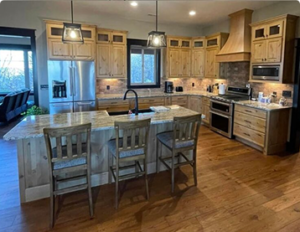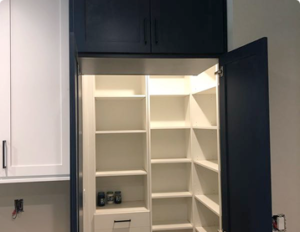

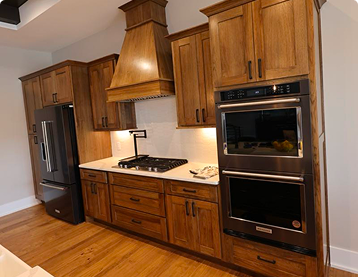
The wood species you choose for your cabinets affects everything: how they look, how they hold up, how they age, and what they cost. It’s one of the first decisions in any cabinet project, and it’s worth getting right.
There’s no single “best” wood. There’s the right wood for your kitchen, your taste, your budget, and how you live. What you need to know to make that call with confidence.
Hardwood vs. Softwood: The Basics
All cabinet wood falls into two broad categories, and the names can be misleading.
Hardwoods come from deciduous trees, the ones that drop their leaves in fall. Oak, maple, cherry, walnut, hickory. These are denser, more durable, and what you’ll find in most quality cabinetry. They resist dents and scratches better and take finishes well.
Softwoods come from conifers, the evergreens. Pine, cedar, fir. They’re less expensive and easier to work with, but they dent more easily and tend to show wear faster. Pine cabinets have their place, especially in a cottage or farmhouse style, but they won’t hold up the same way in a busy family kitchen.
For cabinetry that’s going to get daily use for decades, hardwood is the stronger choice.
The Most Popular Cabinet Woods
Each species has a distinct look and personality. An honest look at the options we work with most:
Oak is the workhorse of American cabinetry. It’s hard, affordable relative to other hardwoods, and has a pronounced grain pattern that gives cabinets visible texture and character. Red oak runs warmer with pinkish undertones. White oak is cooler and more neutral, with a tighter grain. White oak has been trending for the past few years, and for good reason. It stains beautifully and pairs well with both modern and traditional kitchens.
Maple is smooth and fine-grained, almost uniform in appearance. If you want a clean, contemporary look with a painted or light-stained finish, maple is hard to beat. It’s extremely hard (harder than oak on the Janka scale), takes paint like a dream, and hides very little grain. The flip side: because the grain is subtle, any stain applied to maple can look blotchy if not done carefully. A skilled finisher knows how to handle this, but it’s worth knowing upfront.
Cherry is where wood starts to feel like furniture. It has a warm, reddish-brown tone that deepens with age and sunlight exposure. New cherry cabinets look good. Cherry cabinets five years later look incredible. The grain is smooth with occasional mineral streaks that give each piece its own character. Cherry costs more than oak or maple, but for homeowners who value how their kitchen ages, it’s a worthwhile investment.
Walnut is the darkest of the common domestic hardwoods, with rich chocolate and coffee tones. It makes a strong statement, especially in a kitchen that uses walnut for the island or accent cabinets while keeping perimeter cabinets lighter. Walnut is softer than maple and oak, so it will show wear more readily in a high-traffic kitchen. Many people consider that part of its charm.
Hickory is the hardest and most rustic option on this list. It has dramatic grain variation, with streaks of light and dark running through every board. No two hickory doors look alike. This makes it perfect for a cabin, lodge, or farmhouse aesthetic. It’s less suited for a sleek modern kitchen where uniformity matters. Hickory is tough enough to handle anything a kitchen can throw at it.
Painted vs. Stained: A Decision That Shapes Everything
The finish choice is almost as important as the wood choice. It changes how the wood looks, how it wears, and how much you’ll spend.
Stained cabinets let the wood show through. You see the grain, the character, the natural variation between boards. Staining works best on woods with interesting grain patterns: oak, cherry, hickory. A stain enhances what the wood already has.
Painted cabinets cover the grain entirely. The focus becomes the door style, hardware, and color. Paint works best on smooth, fine-grained woods like maple and poplar. Painting over a heavy-grained wood like oak can look uneven because the grain texture shows through the paint.
A practical consideration: painted cabinets show chips and dings more visibly than stained ones. A nick in a stained oak door blends in. The same nick on a white painted door is noticeable. This matters if you have kids, pets, or a kitchen that sees real life.
Many kitchens today mix both. Painted perimeter cabinets with a stained island is one of the most popular combinations right now, and it works because the contrast creates visual depth without overwhelming the space.
Plywood vs. Particle Board: What’s Behind the Doors
The wood species and finish are what you see. But what the cabinet boxes are made from is what determines how long they last.
Particle board and MDF (medium-density fiberboard) are common in lower-cost cabinets. They’re smooth, consistent, and inexpensive. They also swell when exposed to moisture and can’t hold screws as firmly over time. In a kitchen where water, steam, and humidity are constant, this matters.
Plywood cabinet boxes are stronger, more moisture-resistant, and hold hardware securely for decades. They cost more, and they’re worth it. A custom cabinet built on plywood with hardwood doors and drawer fronts is built to last the life of the home.
We build our cabinet boxes from plywood and use solid hardwood for doors, drawer fronts, and face frames. Every piece is cut and assembled in our shop. We don’t use particle board because it doesn’t meet the standard we hold for work leaving our building.
How to Choose
If you’re staring at wood samples and feeling overwhelmed, a simple way to narrow it down:
Start with the look. Do you want to see natural wood grain, or do you want a painted finish? If you want to see grain, lean toward oak, cherry, or hickory. If you want paint, maple or poplar.
Consider your lifestyle. Young kids and a busy kitchen? Go with a harder wood and a stained finish that forgives daily use. Quieter household? Cherry or walnut will age beautifully without as much wear.
Think about the long game. Cherry and walnut both darken and develop richer color over time. Oak and maple stay relatively stable. If you love the idea of cabinets that get better with age, the natural-patina woods are worth considering.
Set your budget. Oak and maple are the most accessible price points. Cherry and walnut run higher. Hickory falls in between. Custom work in any species costs more than stock cabinets, but the difference in fit, finish, and longevity is something you’ll notice every day.
The best way to decide is to see and touch actual samples in the species and finishes you’re considering. We keep samples of every wood we work with at our shop in Lebanon. Come see them in person, talk through what you’re building, and we’ll help you land on the right match.
PT Signature Cabinetry
Lebanon, MO
Serving Southwest Missouri, Lake of the Ozarks, and Northwest Arkansas
(417) 718-2400